


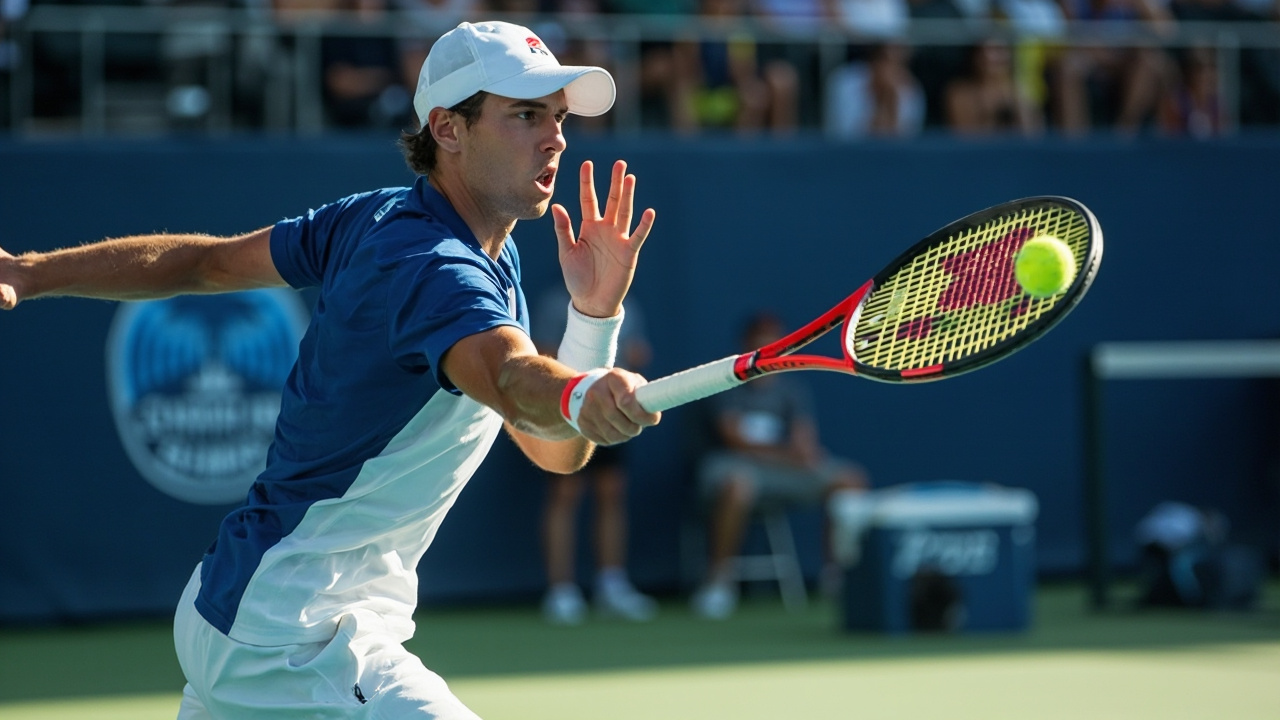
The University of Chicago men’s tennis team saw their championship aspirations come to an abrupt end in the NCAA Division III Quarterfinals, falling to Case Western Reserve University 4-2 in a tightly contested match. This defeat marks the second time this season that the Spartans have bested the Maroons, reinforcing their emergence as a formidable rival in collegiate tennis. Let’s break down this pivotal quarterfinal matchup that showcased elite collegiate tennis at its finest.
Match overview and participants
Match details
The quarterfinal contest between fifth-ranked University of Chicago (23-3) and fourth-ranked Case Western Reserve University (27-5) took place in Claremont, California, with championship implications hanging in the balance. The Spartans secured the critical doubles point early before battling through singles matches to earn their 4-2 victory, advancing to face top-ranked Claremont-Mudd-Scripps in the semifinals.
The narrow margin reflected the closely matched talent of both programs, with several individual matches decided by minimal point differentials. In a rematch of their recent UAA Championship final, Case Western once again demonstrated their ability to perform under pressure against their conference rivals.
Player roster
The match featured accomplished talent from both universities. Chicago’s lineup included Andrei Leonov, Pat Otero, Derek Hsieh, Alexander Ekstrand, Michael Choi, Robert Zhang, Emil Grantcharov, Ajer Sher, and Matthew Liew. Case Western countered with Casey Hishinuma, Anmay Devaraj, Leon Chen, Jon Totorica, Ajay Mahenthiran, Rohan Bhat, George Kosseifi, Matthew Plunkett, and Santiago Salazar Garza.
Each roster reflected the depth necessary for championship-caliber teams, with a mix of experienced upperclassmen and talented underclassmen contributing to their respective programs’ success throughout the season.
Analysis of key moments and team dynamics
Turning points
The match pivoted on several critical exchanges. Case Western seized early momentum by capturing the doubles point, with Mahenthiran and Bhat’s 7-5 victory in the third doubles match proving decisive. This advantage forced Chicago to play from behind throughout singles competition.
Chicago demonstrated resilience with victories at #2 and #5 singles positions, knotting the match at 2-2 and briefly shifting momentum. However, Case Western responded with wins at #1 and #3 singles, before Matthew Plunkett delivered the clinching victory at #4 singles in a dramatic three-set battle (6-3, 0-6, 6-4), exhibiting remarkable mental fortitude after dropping the second set without winning a game.
Team profiles
Chicago entered the quarterfinals with championship aspirations supported by their impressive 23-3 record and #5 national ranking. Their consistency has been remarkable, reaching the NCAA quarterfinals in five of the past six seasons. Despite the loss, their sustained excellence confirms their status as a perennial national contender.
Case Western, sporting a 27-5 record and #4 ranking, has emerged as Chicago’s nemesis this season. The Spartans handed the Maroons two of their four season losses, suggesting a shift in the competitive balance between these programs. Their victory demonstrated both tactical execution and mental toughness, hallmarks of championship-caliber teams.
Inferred strategic considerations
The match revealed several strategic elements worth noting. Case Western emphasized securing the doubles point, recognizing its psychological impact on subsequent singles matches. This approach paid dividends, as Chicago was forced to play catch-up throughout singles competition.
Chicago’s strategy of relying on strength at the #2 and #5 singles positions proved effective but insufficient. Their inability to convert close matches at #3 and #4 singles ultimately proved decisive, with both falling in tight straight sets and three sets, respectively.
Impact, individual highlights, and context
Season impact and program consistency
Despite the disappointing conclusion, Chicago’s 23-4 final record represents another successful campaign. Their consistent ability to reach championship weekends demonstrates program stability and excellence. The loss prevents Chicago from potentially improving their ranking but doesn’t diminish their accomplishments.
Four Chicago individuals will continue their seasons at the NCAA Individual National Championships, providing opportunities for individual accolades even as team competition concludes.
Notable individual performances
Ajay Mahenthiran of Case Western delivered an exceptional performance, contributing to the crucial doubles point and defeating Chicago’s Emil Grantcharov 6-1, 6-4 at #1 singles. Alexander Ekstrand provided a bright spot for Chicago with his composed 6-4, 6-3 victory at #2 singles.
Perhaps most impressively, Matthew Plunkett of Case Western showcased remarkable resilience in his three-set clinching victory at #4 singles, bouncing back from a second-set bagel to secure the decisive point.
Tournament and historical context
This quarterfinal represented a significant step in the NCAA Division III Men’s Tennis Championship, with the winner advancing to face top-ranked Claremont-Mudd-Scripps. The loss prevents Chicago from pursuing their championship aspirations but maintains their status as a consistent national contender.
Historically, Chicago leads the all-time series against Case Western 15-6, but the Spartans’ recent success—including victories in this quarterfinal, the UAA Championship, and the ITA Indoor National Championship semifinal—suggests a shifting competitive landscape between these programs.
Looking ahead
Chicago must now focus on individual performances at the NCAA Championships while beginning preparation for next season. Their consistent excellence suggests they’ll remain championship contenders, but strategic adjustments may be necessary to overcome Case Western’s recent dominance in their rivalry.
For Case Western, the semifinal matchup against top-ranked Claremont-Mudd-Scripps presents an opportunity to continue their impressive run and potentially claim a national championship. Their recent success against Chicago has established them as a legitimate title contender with momentum on their side.
Tennis enthusiasts should also keep an eye on other championship events, including the NCAA Women’s Tennis Championship 2025, the anticipated Wake Forest TCU NCAA Tennis Final 2025 Preview, and even cross-sport championships like the 2025 NCAA DIII Baseball Championship.
Conclusion
The Case Western Reserve victory over University of Chicago in the NCAA Quarterfinals represents both the culmination of a season-long rivalry and a significant milestone in the tournament. While Chicago’s championship aspirations were derailed, their program’s consistent excellence remains undeniable.
For Case Western, this victory validates their season-long growth and positions them for a potential championship run. The razor-thin margins throughout the match highlight the elite level of competition in NCAA Division III tennis, where mental fortitude often proves as decisive as technical skill.
This quarterfinal clash between two tennis powerhouses showcases the depth, intensity, and quality of collegiate tennis at its finest, with both programs continuing to represent the pinnacle of DIII competition.


